Accelerate IT operations with AI-driven Automation
Automation in IT operations enable agility, resilience, and operational excellence, paving the way for organizations to adapt swiftly to changing environments, deliver superior services, and achieve sustainable success in today's dynamic digital landscape.
Driving Innovation with Next-gen Application Management
Next-generation application management fueled by AIOps is revolutionizing how organizations monitor performance, modernize applications, and manage the entire application lifecycle.
AI-powered Analytics: Transforming Data into Actionable Insights
AIOps and analytics foster a culture of continuous improvement by providing organizations with actionable intelligence to optimize workflows, enhance service quality, and align IT operations with business goals.
Imagine walking into a library with millions of books but no catalog, no index, and no librarian. You know the answers are in there somewhere, yet finding them is slow, frustrating, and often inconclusive. That’s exactly how many enterprises operate today: awash in data, yet starving for insight.
This is where knowledge graphs come into play. At its core, a knowledge graph definition refers to a structured data model that connects entities, relationships, and attributes to represent real-world knowledge. By organizing information this way, it enables systems to understand context not just store data and uncover meaningful insights from complex, fragmented datasets.
Gartner further defines knowledge graphs as “graph-based data structures that capture the semantics and relationships among data to support enhanced context, insight, and data-driven decision-making.” Gartner also predicts that by 2026, organizations adopting semantic and graph-based approaches will reduce AI technical debt by up to 75% compared to those relying on traditional architectures.
As enterprises accelerate their investments in AI and digital transformation, these interconnected, semantic structures are becoming foundational. In this blog, we’ll explore what knowledge graphs are, how they work, their key characteristics, and how leading organizations are using them to unlock new value.
A recent survey found that 48% of M&A professionals are now using AI in their due diligence processes, a substantial increase from just 20% in 2018, highlighting the growing recognition of AI’s potential to transform M&A practices.
What is a Knowledge Graph?
A knowledge graph is a machine-readable, semantically rich data structure that models real-world entities such as people, products, services, or digital assets and the relationships between them. It organizes this information in the form of nodes (entities) and edges (relationships), building a web of context rather than isolated records. KGs represent both physical and digital knowledge, linking disparate data sources to reveal how things are connected, not just what exists.
First introduced at scale by Google to enhance search by focusing on “things, not strings,” knowledge graphs have since matured into strategic assets for modern enterprises. Today, they drive a wide range of capabilities — from intelligent automation and real-time decisioning to enriching AI models with context-aware insights. More than just revealing what your data contains, a knowledge graph uncovers the how, why, and what’s next — transforming raw information into actionable intelligence.
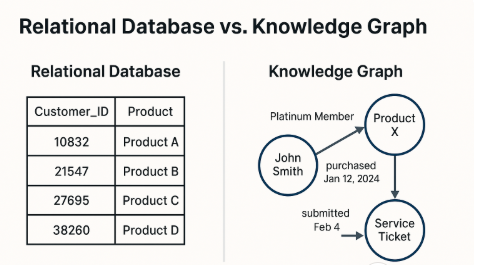
What makes KGs especially compelling is their ability to link data across silos using meaningful relationships and surface it in a format that both humans and machines can interpret. In contrast to relational databases that store tabular data with limited relational depth, KGs provide a dynamic, flexible way to explore the interconnected nature of business entities.
Example:
- Traditional view: Customer_ID = 10832
- Knowledge graph view: “John Smith is a Platinum Member who purchased Product X on January 12, 2024, and submitted a service ticket on February 4”
Related Content: How to Build a Knowledge Graph: 10 Simple Steps
How Knowledge Graphs Works
At the heart of a knowledge graph is the concept of a triple — a combination of subject, predicate, and object that expresses a single fact. For example:
“Employee123” — “reportsTo” — “Manager456”
These triples form a semantic graph, enabling complex queries such as:
“Show all customers in the EU who purchased Product Z and currently have open support tickets.”
A relational database might require multiple tables joined to answer this; a knowledge graph can deliver it with a single graph traversal.
Graph Construction Essentials
Creating an enterprise-ready knowledge graph involves several key components:
- Data Ingestion Pipelines
Integration of data from sources such as relational databases, APIs, spreadsheets, documents, and real-time systems.
- Entity Recognition and Linking
Using natural language processing and machine learning to identify meaningful concepts and unify them across sources.
- Ontology Frameworks
Domain-specific models that define classes (e.g., customer, invoice, asset) and the relationships that can exist between them.
- Reasoning Engines
Algorithms that infer new knowledge by applying logical rules and constraints — such as deriving that a customer is “at risk” based on interactions and purchase patterns.
The result is a continuously evolving, machine-readable graph that not only reflects reality but also anticipates it. As organizations accumulate more diverse data, knowledge graphs offer a scalable, intelligent way to bring everything together — unlocking insight from complexity.
Key Characteristics of Knowledge Graphs
So, what makes knowledge graphs stand out in a world filled with data tools and technologies? The secret lies in how they mimic the way we, as humans, understand the world — through relationships, context, and meaning.
Here’s what gives them their edge in today’s enterprise landscape:
1. Contextual and Semantic Awareness
Traditional databases tell you facts. Knowledge graphs tell you stories. They connect the dots between people, systems, products, and events — creating a rich, semantic network where data makes sense. Instead of just retrieving information, they help you discover insights.
2. Schema Flexibility and Evolution
Business is anything but static. New processes emerge, priorities shift, and systems evolve. Knowledge graphs adapt easily. You can add new entities and relationships without overhauling your existing structure. They’re built to change as your business changes.
3. Unified Integration Layer
Data comes in all shapes and formats — spreadsheets, databases, APIs, emails, even PDFs. Knowledge graphs can integrate all of it. They act like a connective layer that brings everything into one coherent, searchable map, no matter where the data lives.
4. Powerful Relationship Traversal
Want to find every customer who interacted with your service team more than three times last month and then churned? A knowledge graph can give you that in seconds. Its ability to traverse relationships is what makes it incredibly powerful for analysis, pattern recognition, and decision-making.
5. Transparency, Trust & Explainability
One of the biggest challenges with AI is explainability. Why did the model make that decision? Knowledge graphs help answer that. Every relationship in the graph is traceable, so you can follow the logic, understand the connections, and build trust in your AI outcomes.
6. AI-Ready Foundation
Large language models are great at generating responses, but sometimes they make things up. Knowledge graphs bring structure, facts, and grounding — giving AI a reliable knowledge base to work with. The result? Smarter, more accurate, and more explainable systems.
In short, knowledge graphs bring the human-like ability to connect, reason, and adapt into enterprise data systems. They don’t just organize your information — they help you make sense of it, evolve with it, and get more value from it every step of the way.
Challenges in Implementing Knowledge Graphs
While knowledge graphs hold immense promise for transforming enterprise data into contextual intelligence, their implementation is far from straightforward. Unlike traditional data projects, knowledge graph initiatives require a deeper alignment between business semantics, technical infrastructure, and long-term governance. Below are the key challenges enterprises face when attempting to build and scale knowledge graphs:
1. Data Silos and Fragmentation
One of the biggest hurdles is the fragmentation of data across various systems, departments, and geographies. Enterprises often deal with structured data in databases, semi-structured data in XML/JSON, and unstructured data in emails, documents, and logs. These disparate sources make it difficult to construct a unified and coherent knowledge graph without significant data integration efforts.
The Challenge: Integrating this data into a single graph without losing meaning or introducing inconsistencies.
2. Lack of Semantic Standards
To construct a meaningful knowledge graph, you need well-defined ontologies and taxonomies that describe how entities relate to one another. However, many enterprises either lack standardized semantic models or have conflicting definitions across business units.
The Challenge: Without common vocabularies, the graph can’t achieve true interoperability or reflect enterprise-wide understanding.
3. Data Quality and Consistency
Knowledge graphs rely heavily on clean, accurate, and consistent data. Duplicate records, missing attributes, incorrect relationships, and inconsistent naming conventions can severely degrade the value of the graph.
The Challenge: Ensuring high data quality across sources—especially when relying on legacy systems or manual inputs.
4. Scalability and Performance
As graphs grow in size—adding millions of nodes and relationships—query performance can deteriorate. Enterprises require graph technologies that can scale horizontally while supporting real-time updates and low-latency queries.
The Challenge: Balancing graph complexity with system performance, especially under high data velocity and volume.
5. Lack of Skilled Talent
Graph theory, semantic modeling, RDF/SPARQL, and ontology design are specialized skills that aren’t widespread. Many enterprises lack in-house expertise or face a steep learning curve when adopting these new paradigms.
The Challenge: Bridging the talent gap while upskilling teams for long-term sustainability.
6. Tooling and Platform Maturity
While graph databases like Neo4j, Amazon Neptune, and Stardog have matured, many organizations still struggle with integrating them into existing data pipelines, DevOps workflows, or enterprise data lakes.
The Challenge: Selecting the right toolset and ensuring seamless integration with existing enterprise systems.
7. Governance and Access Control
A knowledge graph typically spans sensitive information—customer data, business processes, financial relationships. Enforcing fine-grained access controls, audit trails, and data lineage is non-trivial.
The Challenge: Balancing openness and usability with security, privacy, and compliance requirements (like GDPR or HIPAA).
8. Change Management and Adoption
Switching from traditional relational thinking to graph-based models requires cultural change. Business and technical stakeholders need to understand how to use and trust a knowledge graph for decision-making.
The Challenge: Driving organizational buy-in, training users, and ensuring adoption across roles and functions.
9. Maintenance and Evolution
A knowledge graph isn’t static. As your business changes, new systems are introduced, and ontologies evolve, the graph must be updated regularly. This requires ongoing maintenance, version control, and governance.
The Challenge: Keeping the graph current and aligned with business realities without excessive overhead.
10. Demonstrating ROI
Perhaps the most pressing challenge is proving the value of a knowledge graph to stakeholders. Without tangible use cases and measurable outcomes, initiatives can lose momentum or funding.
The Challenge: Aligning graph development with business KPIs and delivering quick wins to justify long-term investment.
Benefits of Using Knowledge Graph
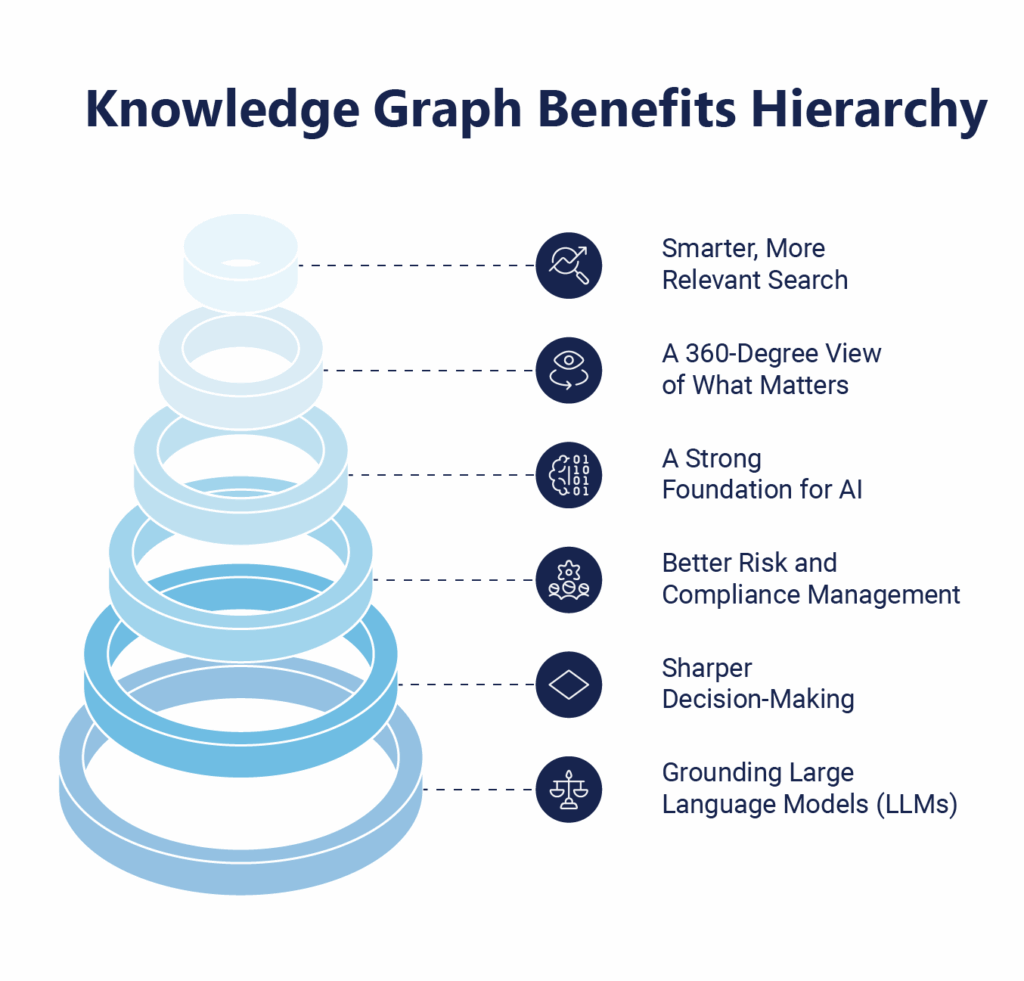
Knowledge graphs do more than organize your data — they unlock it. They help you move from scattered information to meaningful insights, faster decisions, and smarter AI. Whether you’re looking to simplify complexity, personalize experiences, or increase transparency, KGs offer a wide range of benefits across business, technology, and AI.
1. Smarter, More Relevant Search
Ever felt like your systems don’t really understand what you’re searching for? Knowledge graphs change that. By using semantic search, they grasp the intent behind queries — not just the keywords. This allows users to get faster, more accurate results, even when asking in natural language
2. A 360-Degree View of What Matters
Imagine seeing every customer, supplier, product, or IT asset — and understanding how they all connect. Knowledge graphs bring together data from across your ecosystem to create complete, unified views. This helps teams make more informed decisions, faster.
3. A Strong Foundation for AI
AI systems are only as good as the context they’re trained on. Knowledge graphs provide that context. They enhance AI models by connecting facts, uncovering relationships, and offering structure — making outcomes more accurate, explainable, and scalable.
4. Better Risk and Compliance Management
In industries where rules are strict and ever-changing, knowledge graphs help keep everything in check. They map regulations, identify risks, and track compliance obligations across business units and geographies. This simplifies audits, strengthens governance, and reduces exposure
5. Sharper Decision-Making
By revealing hidden connections and patterns, KGs empower leaders with decision intelligence. From diagnosing root causes to running what-if scenarios, they support better planning and more predictive insights — especially in complex environments
6. Grounding Large Language Models (LLMs)
LLMs are powerful, but without guardrails, they can go off track. Knowledge graphs act as a factual backbone, grounding generative AI in reliable, structured knowledge. This is critical in sectors like healthcare, banking, and legal, where accuracy is non-negotiable.
Knowledge Graph vs Graph Database
A knowledge graph database stores interconnected data using nodes and relationships, often implemented using graph database technology. While a graph database provides the storage infrastructure, a knowledge graph adds semantic meaning, ontologies, and contextual relationships to the data.
| Aspect | Knowledge Graph | Graph Database |
|---|---|---|
| Definition | A knowledge graph is a semantic layer that connects entities, relationships, and context to represent real-world knowledge. | A graph database is a database designed to store and query data using nodes and relationships. |
| Primary Purpose | To provide context, meaning, and insights from connected data | To store, manage, and query graph-structured data efficiently |
| Data Structure | Includes entities, relationships, attributes, and ontologies | Uses nodes (entities) and edges (relationships) |
| Intelligence Layer | Adds semantic meaning and reasoning capabilities | Does not inherently include semantic understanding |
| Technology Role | Built on top of graph databases or other data systems | Acts as the underlying storage technology |
| Query Capability | Supports contextual queries and inference-based insights | Supports graph queries |
| Use Cases | AI, recommendation systems, enterprise data integration, search engines | Fraud detection, network analysis, relationship-heavy data queries |
Use Cases and Applications of Knowledge Graphs
Knowledge graphs are being adopted across industries to solve some of the most persistent data challenges — from smarter search and personalization to AI-driven operations. Below are some of the most impactful use cases:
1. Search and Discovery
Leading tech platforms use knowledge graphs to elevate their search experience. For example, travel platforms connect user preferences, past bookings, seasonal data, and local experiences to offer hyper-personalized suggestions — going far beyond keyword search to deliver intent-based recommendations.
2. Enterprise Data Integration
Pharmaceutical giants have implemented knowledge graphs to unify R&D data across drug discovery, clinical trials, regulatory documents, and academic literature. The result is a consolidated view that shortens research cycles and improves decision-making in real time.
3. Compliance and Risk Intelligence
In the financial sector, knowledge graphs map complex transaction flows and inter-entity relationships to detect fraud, monitor regulatory compliance, and assess systemic risks. Unlike relational databases, KGs can trace suspicious activity across multiple degrees of separation.
4. Customer 360 and Personalization
Digital streaming services use knowledge graphs to understand user behavior at a granular level. By connecting users with songs, genres, moods, and context (time of day, activity), they can generate truly personalized playlists and recommendations.
5. Digital Twins and Intelligent Operations
In IT and manufacturing, knowledge graphs help create real-time digital twins of assets, processes, and environments. By modelling the relationships between applications, APIs, services, and incidents, organizations can enable faster root cause analysis, self-healing systems, and predictive maintenance.
6. Agentic AI and Intelligent Agents
As AI systems evolve into autonomous agents, knowledge graphs play a vital role in grounding their actions. They serve as a live, dynamic model of the world — enabling agents to reason, plan, and make decisions with context and continuity.
7. Healthcare and Life Sciences
Healthcare innovators use knowledge graphs to improve clinical trial design, patient stratification, and drug safety monitoring. By connecting patient records, protocols, trial outcomes, and medical literature, KGs enhance both research accuracy and regulatory compliance.
8. E-commerce and Intelligent Recommendations
E-commerce platforms leverage KGs to understand how products relate to one another, how customers behave across touchpoints, and how preferences shift over time. This helps power everything from upselling and bundling to dynamic pricing and cross-category recommendations.
These applications illustrate why knowledge graphs are becoming foundational to enterprise intelligence. They are not just a better way to manage data — they are a smarter way to make sense of it.
Conclusion
In a world drowning in data, it’s not more information we need – it’s smarter connections. Knowledge graphs offer exactly that: turning scattered data into structured, contextual intelligence that drives real business outcomes.
From powering AI with deeper understanding to enabling faster, more confident decisions, knowledge graphs are becoming the backbone of modern enterprise innovation.
Ready to turn complexity into clarity? Explore how knowledge graphs in Qinfinite, our intelligent application management platform can be your strategic edge powering better decisions, richer customer experiences, and more trustworthy AI.
Connect with us today and see how it all connects.
FAQs Related to Knowledge Graph
A knowledge graph is a structured data model that represents real-world entities and the relationships between them. It connects data points into a network, enabling systems to understand context, improve search results, and power AI-driven insights.
Key components include entities (nodes), relationships (edges), triples (subject–predicate–object), ontologies for structure, and data ingestion layers to unify sources.
Common use cases include fraud detection in banking, drug discovery in pharma, and incident root-cause analysis in IT operations, intelligent search, recommendation engines, and compliance management.
Enterprises use KGs for regulatory risk tracking, real-time IT operations, personalized customer journeys, and AI model enrichment with structured, contextual data.
Knowledge graphs are important because they connect fragmented data into a unified, contextual view. This enables better decision-making, improves AI and machine learning models, enhances search and recommendation systems, and supports real-time insights across enterprise applications.